After the breathless thrill ride of my last two posts, this week’s offering largely concerns a spreadsheet. Everyone loves a spreadsheet, by which I of course mean my friend Bethan loves a spreadsheet. I’ve changed her name slightly to protect her identity, not that she, or indeed anyone else, reads this nonsense. That’ll teach me to make friends who have got better things to do with their time.
Anyway, the spreadsheet. When I planned this blog, I blithely perused the information pertaining to the season of my chosen appley quarry but didn’t really put a lot of thought into it, presuming that the seasons mentioned corresponded loosely to those of the actual calendar: early meaning January to March, that sort of thing. Nope. Not even a little bit. It turns out that early means early for apples, not early for archaic Gregorian calendars. Thus, it transpires that the William Ingall apple variety, located squarely in the middle of the early season, doesn’t actually bother to turn up until July. Which is three months away. Don’t get me wrong, I love my mate Martin and enjoy talking to him, but three months is a long time to nurse a can of Old Speckled Hen whilst waiting to see if an apple starts growing.
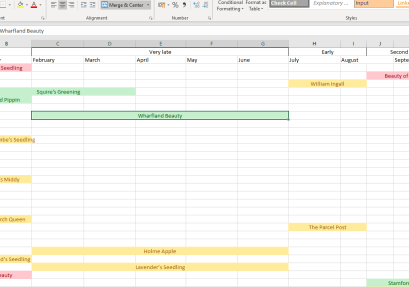 The William Ingall is on the backburner.
April, where we are now, corresponds to the very middle of the very late apple season. That narrows down my haul of targets to exactly five varieties. In no particular order, they are the Wharfland Beauty, the Holme Apple, Lavender’s Seedling, the Shakespeare and the Peacock. The Shakespeare and the Peacock will be the name of my boozer when I open it. In my dreams.
Now, I’m nearly two months into the apple hunting business and the days when I would write those names down on a post-it note and walk to the bus stop are behind me. I checked the various books and sources of dusty information I have access to, and colour coded them (check me out, Mr Fancy Pants Spreadsheet Lar-di-dah Gunner Graham) according to how much information I’ve got. Red if I’ve got nothing but a name (all clear), yellow if I’ve got either a description of the apple or the name of the grower (fare thee well Holme Apple, Lavender’s Seedling, the Shakespeare and the Peacock) and green if I’ve hit the jackpot and have both the name of the grower and a description of the fruit. Step right up, Wharfland Beauty, you are officially a winner.
According to the National Apple Register, everyone’s favourite bedtime reading, the Wharfland Beauty was a “chance seedling found at Oakham, Rutland, introduced by Brown of Stamford.” Furthermore, its appearance was described as “like Golden Reinette.” Also, it has a decent name. better than the William Ingall. Not quite the Peasgood’s Nonsuch. The only slight issue is that it hasn’t been seen since 1880 but I am undeterred. As a great man once said, “There never was much hope. Just a fool’s hope.”
Now the problem here is one of moral purity. The apple was raised by chance in Rutland, one of those terrible other counties you read about outside Lincolnshire, but it was brought back to the blessed realm and cultivated in Stamford, which is definitely Lincolnshire. It’s dodgy but it’s all I’ve got in the green bumper description and history section of my spreadsheet.
A quick potter around the internet leads me to the website of Stamford Community Orchard Group (hereafter referred to as SCOG) who, it turns out, appear to have done all my work for me. In fact, their stated mission (to preserve the heritage apple varieties of Stamford and to attempt to retrieve lost varieties) sounds a lot like the alleged but as yet unproven purpose of my blog. We could be rivals but if the last ten weeks of posts have proven anything, it’s that I am no man’s rival. These guys have groups of people working together towards a common goal and seem to know what they’re doing. I am one socially inept goon sat in his bedroom trawling the internet and shelling out cash on poorly thought out bus trips. We could work together but I doubt I’d have much to offer.
Anyway, sat proudly on the SCOG website is a potted history of the aforementioned Mr Brown who, it turns out, started orcharding in 1830 and built something of a dynasty in the local area. He won prizes and awards and some of his varieties are still around today. Eventually his offspring drifted off around this country and others and the nursery they pioneered lost out to cheaper and more convenient out of town garden centres. He left behind nothing but a selection of locally available apples and something for me to waste money and time on.
SCOG also hold annual Apple Days in which people turn up with apples from their trees and the group try to identify them and see if anything previously lost turns up. Local papers have been reporting on them for years and, much to my annoyance, in 2016 made a pun out of the word appeal (a-peel). How come I didn’t think of that?
So where do I go from here? I could write another post on my intrepid trip up the road to buy some plant pots but it turns out that Stamford Community Orchard Group have a community orchard. There was probably a bit of a clue in their name. I smell a bus trip on the horizon.

 The Appeal of Mrs Toogood
Leave a comment