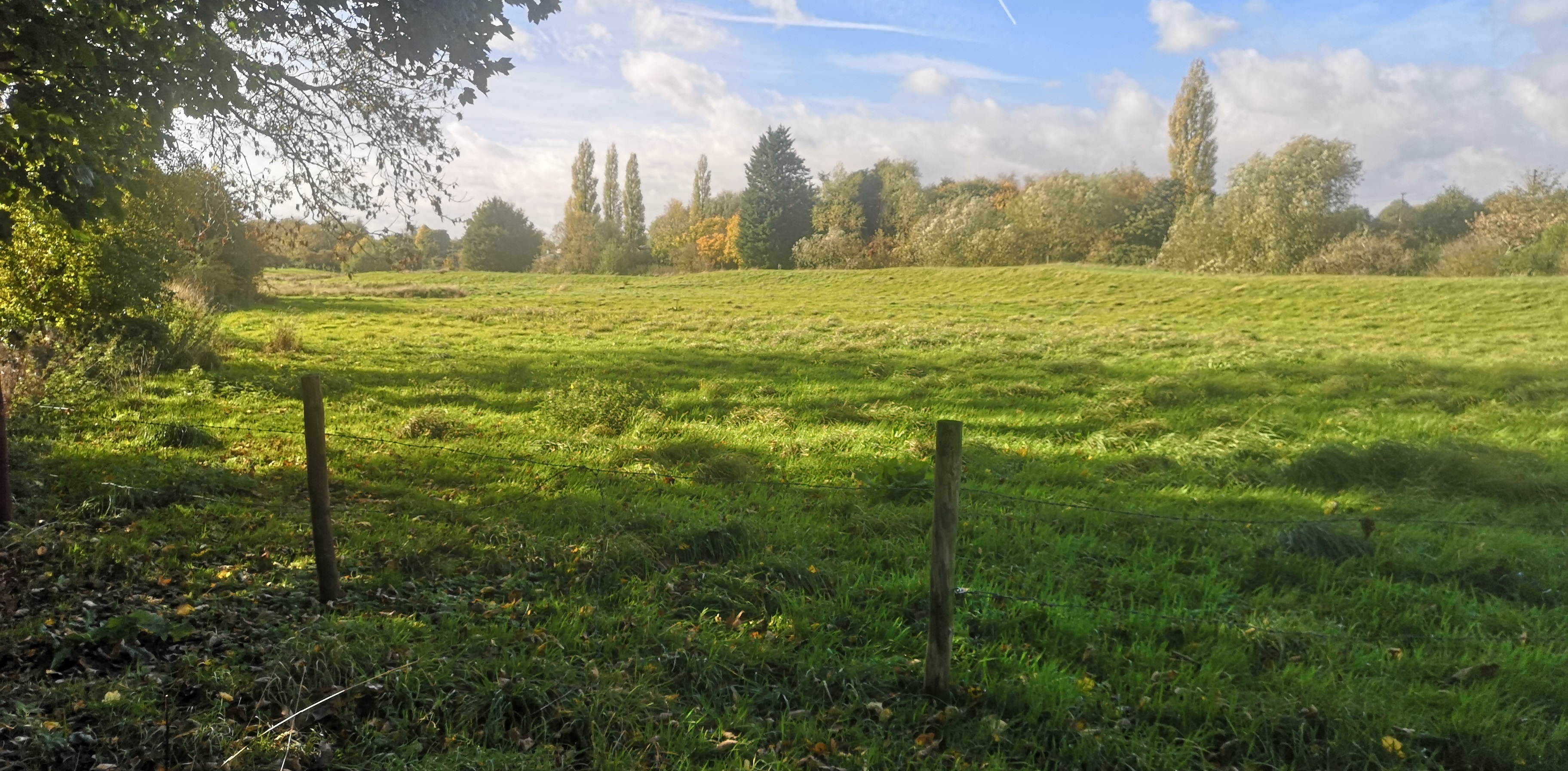
The next tree on my hit list is one my dad told me about last year but which I hitherto considered too far to bother with on account of it being nowhere near a bus stop. I should perhaps have tested the fruit before deciding to grow another version of it but it’s too late for that now. The tree has spent its days beside a footpath that crosses fields between the villages of Stewton and Keddington, enjoying a life of unsullied peace and quiet. Until today that is, when two beardy yobbos from Louth will set out to remove from it new growth suitable for grafting. I promise to be respectful and never again bother it if only it will allow us to prat around with some pruning shears on this one single occasion.
I’ve invited my friend Stephen along for the day, hoping his practical skillset and cheery Brummie optimism will be of some use later in the day when it comes to the technical bits. I’ve told him that even if the tree isn’t there, we’ll at least have a lovely walk through the countryside and plenty of chance for a bit of banter. Just in case we end up disappointed, I’ve secretly packed two bottles of cider wrapped in tea towels so they don’t give the game away. I know I’m making assumptions about him being ok with boozing in the morning but I think I’m on pretty safe ground.
I’ve got the pruning shears I’ll need for taking samples and a sharp knife for the grafting bit. We will be using the whip and tongue method that I learned from a random YouTube video. Although the host, who looked weirdly like Thom Yorke from Radiohead but a bit happier, said it was the most difficult to perfect he also said it was the most likely to work so that’s the one I’m going for. There are certainly other methods but I’ll only get confused if I look at them now.
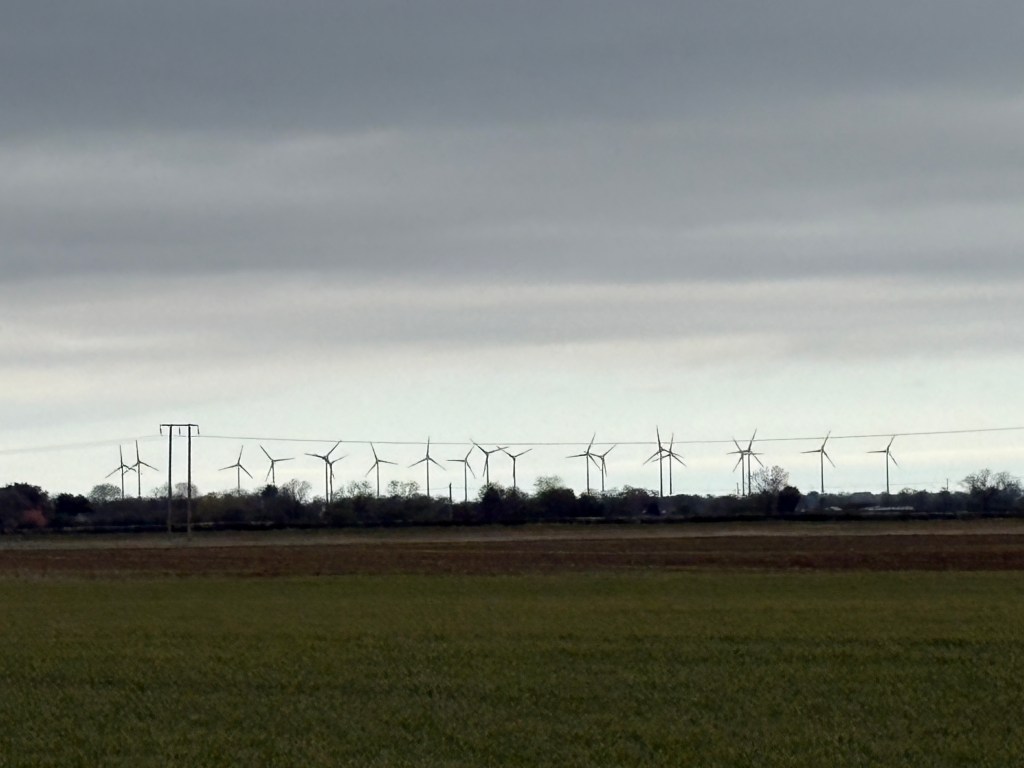
Heading away from my house, the first part of our walk is along Stewton Lane, a tree lined country road with very little traffic. We pass a couple of tractors pulling down trees and levelling surfaces in one field, presumably preparatory work for a house or a barn but there’s not much other activity. What houses there are look sturdy and settled into the environment, there forever and going nowhere. The lane doesn’t wind so much as meander along like a tarmac stream until we reach the village.
Last time I was here there were two old fellas with impressive beards and scruffy dogs passing the time of day in the middle of the road, but there’s no-one about today. It’s a shame because I had a hankering to exchange pleasantries and properly compare facial hair. One of the chaps had a mid chest length effort separated into two bunches that I’ve been dreaming about enviously.
The lane heads left and then curves back towards a charming church poking out of the trees, host to a booming congregation every other Sunday. I’ve been along a couple of times myself. It’s open during the day, allowing visitors to have a sit down and peruse the impressive selection of twinned toilets its parishioners fund. The building itself inspired the official Hornby church model and there is a small display near the chancel. I say chancel; it might be the nave or transept for all I know. I’m just guessing and hoping no-one knows enough to correct me.
Back on the road, it’s time to use my dad’s map to navigate our way to the tree except that it turns out I’ve left it at home. It’s a shame because I quite liked it but no problem; I give the old boy a ring and he sorts me out with some verbal directions. The map itself is going into my orchard scrapbook as soon as I get one. It’s a piece of history now.
There are other ramblers and dog walkers on the footpath, and all of them are chatty and friendly. It must be the weather or scenery or more likely a mixture of both. An elderly couple mistakenly feign interest in our mission and I bang on about apples until they realise it’s getting late and they need to be home in time for Countdown.
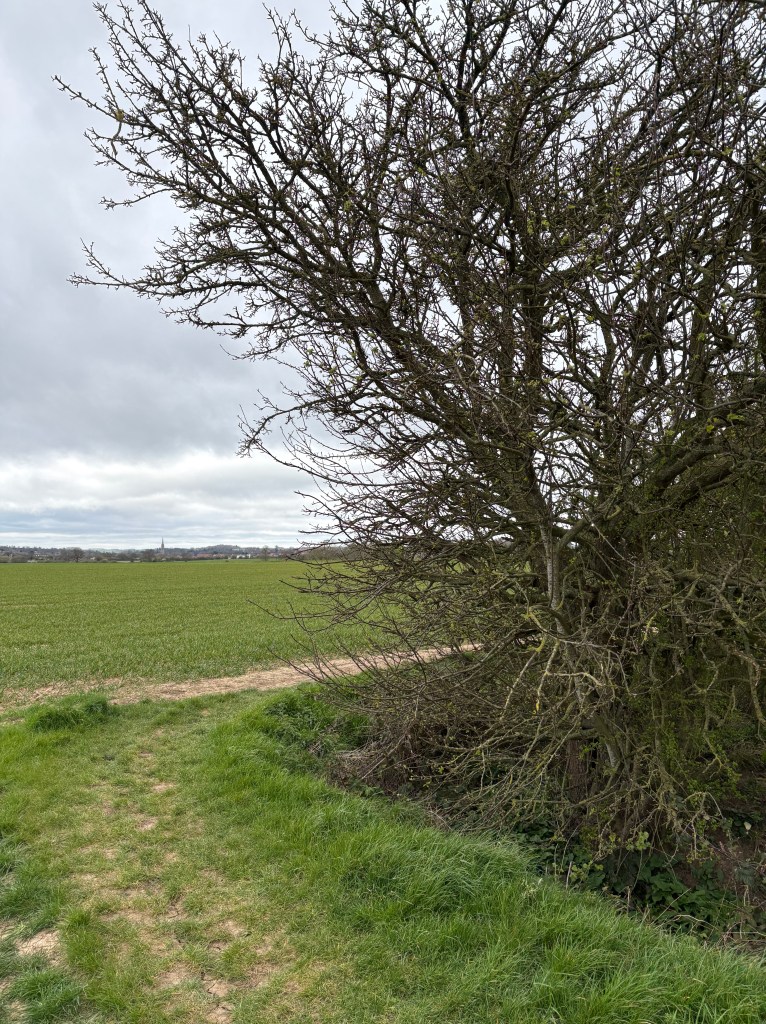
The tree stands next to a ditch between two grassy fields. It requires a bit of clambering and reaching but we manage to get four promising bits of new growth which won’t hurt the tree without falling into the nettles below. Another dog walker hurries past; he’s probably been warned against making eye contact by the Countdown fans.
The rest of the footpath takes us through some attractive woodland and we pause regularly to listen to the birds. I try to record it all on my phone but the sound of the wind ruins the recording. Later on, a birdsong app claims it was a Chaffinch. I’m not convinced but it seems confident. Who am I to doubt the wisdom of AI?
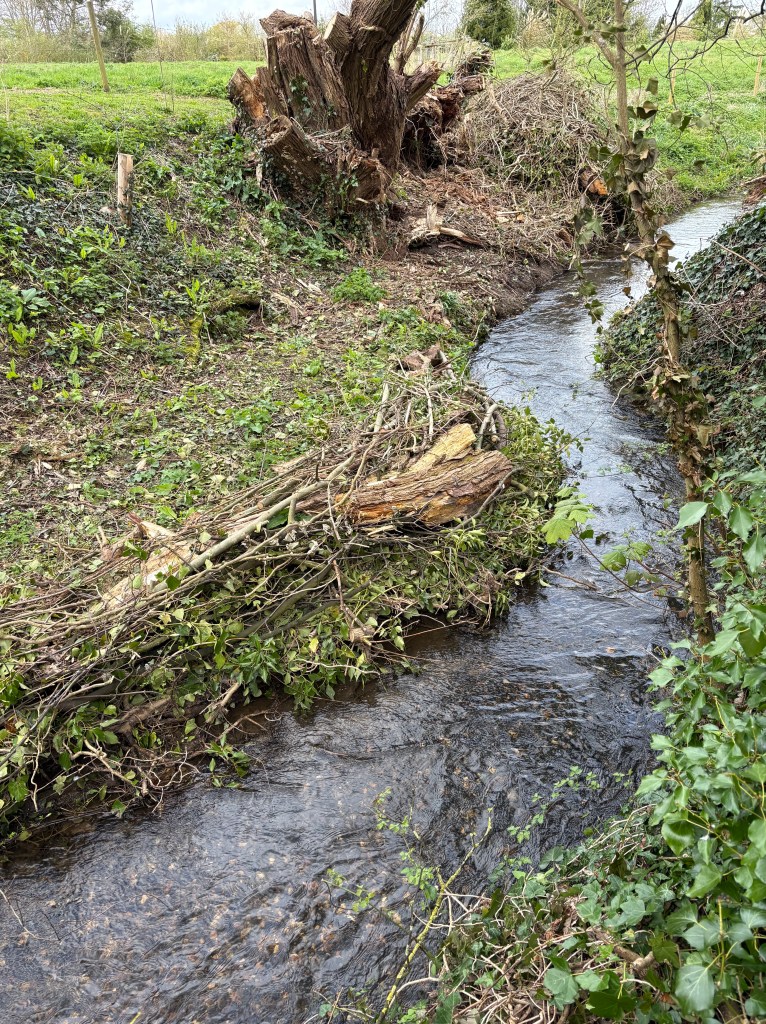
We eventually emerge on Eastfield Road, just across from the small plot that I’m considering calling Riverbend Orchard but which my dad refers to as Stan’s Corner on account of my cat being buried there. We have a choice to make; either we follow the road and stay dry or we jump across the river and almost certainly get wet. Caution prevails and we walk for another ten minutes round to the trees, at which point it’s time to unload my grafting kit and scions (posh name for twigs).
The grafting itself is delayed by a snack and a chat with my dad who is on site to plant some grass seed or, as he pessimistically refers to it, food for the birds. For someone who harbours so many doubts about its chances of survival, he puts a lot of effort in, raking the ground vigorously to make sure the seeds are at least mostly hidden by earth. I’m slightly nervous now because I’ve only bought two ciders but his internal lunchtime clock drags him away after a few minutes and we see no more of him. I don’t think he drinks cider anyway.
I knew I’d bodged up by planting my rootstocks without grafting first but the extent of my foolishness is only starting to dawn on me now. Slicing through the planted rootstocks and lining up root and scion is much more fiddly than it would be if you could turn them around and about in your hands. Before I’ve got the first scion grafted on, there’s blood gushing from three of my fingers and Stephen is looking pale. He produces a bunch of plasters from his wallet and I use all of them to stench the flow, but not before I’ve stained the handle of our knife a deep red.
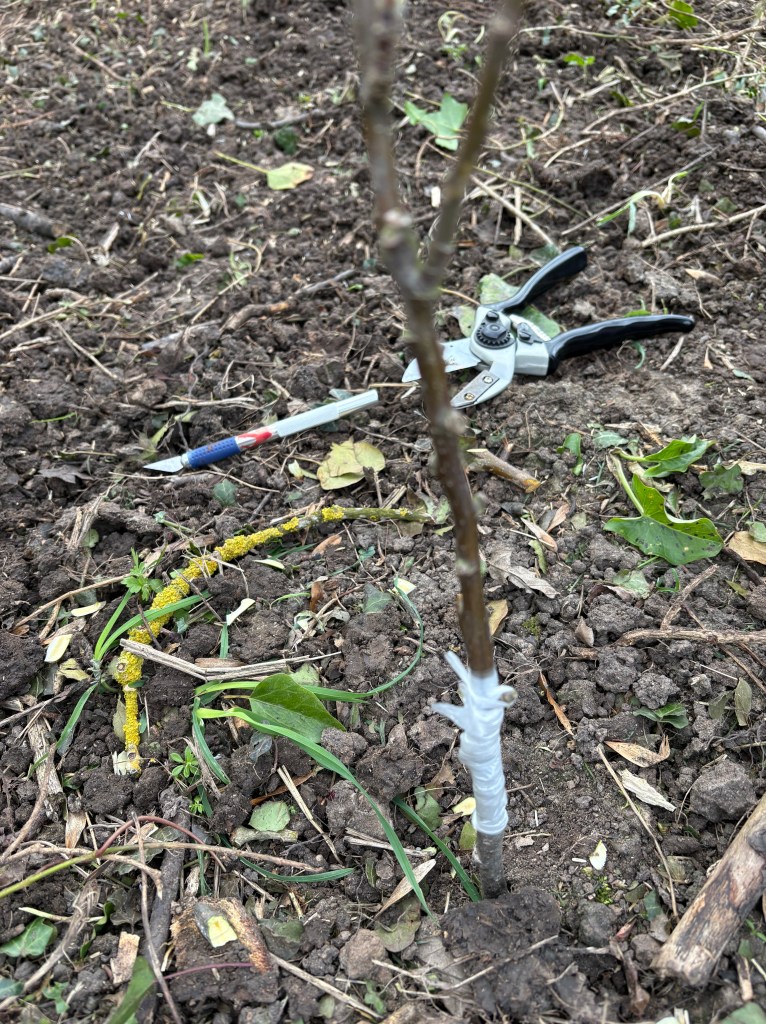
Stephen says words to the effect that I’ve got no business holding a sharp knife and should immediately concede the cutting role to him. I retort by accusing him of being a Negative Norman for carrying plasters in his wallet anyway and, besides, what he’s clearly overlooking is that I’ve still got seven fingers I haven’t injured yet.
My arguments fail to convince and I’m relegated to taping duty. To bond our scion to rootstock we need to cut diagonally below a bud on the rootstock and above a bud on the scion and then cut a notch in each. If you were to look at a cross section of the apple branch, you would see the outer bark and then a thin layer of green regenerative tissue that is called the cambium layer. The technique we are using aims to line up as much of this layer as possible. It prompts a good hour or so arguing about where the best place to cut the notch is and to this very day I maintain that the official advice makes no sense. The two bits of tree are then pressed together, forming a sort of z-shaped joint.
Once that’s done, you wrap the whole area in grafting tape or, in our case, freezer bags cut into strips. And that’s it. All that’s left to do is water the tree when needed and watch videos so you can see what you did wrong.
We graft three times, twice from Stewton and once from Legbourne, leaving space for two more local trees that I’ll reveal in a future episode. To be honest, I expect all three to fail miserably but Stephen is displaying a frankly bizarre confidence in horticultural skills he learned about an hour ago. I just can’t accept that something as marvellous as cloning apple trees can be mastered by two idiots in such a short space of time. Next year we’ll have another go. I retrieve the cider from my bag and we share a drink, toasting to success and two trees preserved for the ages. Or at least until they compulsorily purchase the field and build a housing estate over my family’s hopes and dreams.


 The Appeal of Mrs Toogood
Leave a comment